Who Am I Now? The Midlife Question Nobody Prepares You For.
The identity transition that happens alongside the physical one — and why it matters

You expected the hot flashes.
Maybe the fatigue. The brain fog. The weight that shifted without warning.
You’d heard about those.
What nobody told you about was this:
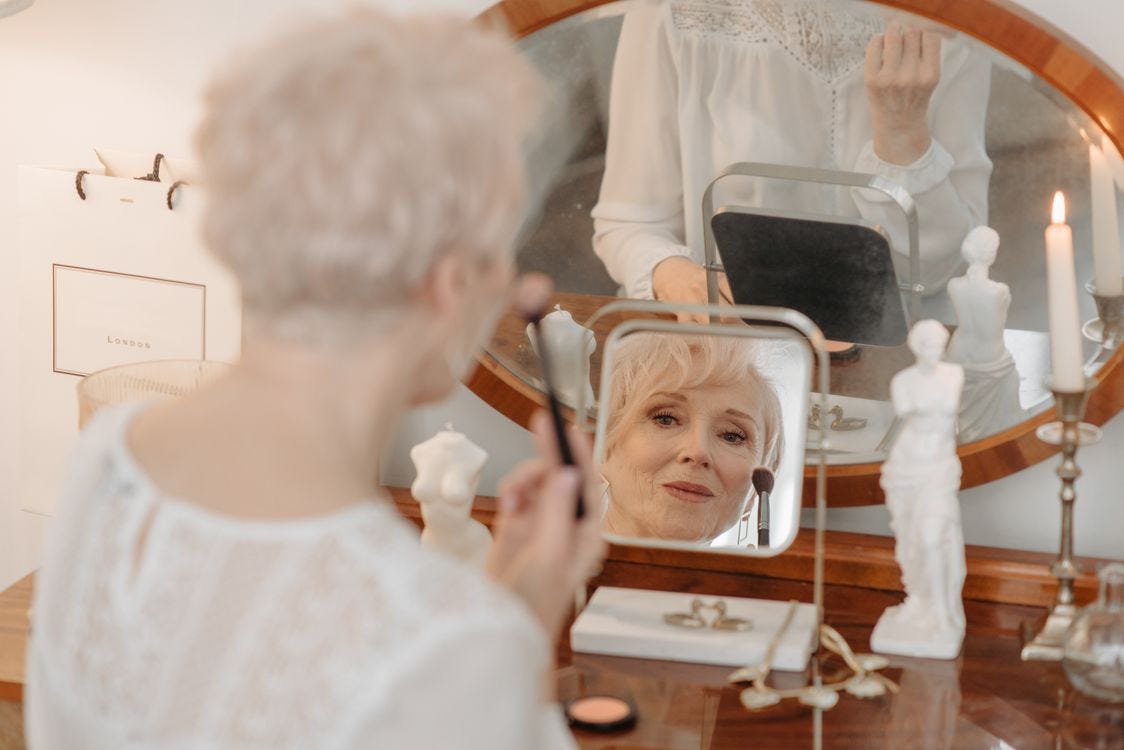
The strange feeling of not quite recognising yourself.
The irritability that seems disproportionate. The relationships that feel different. The career you built that suddenly feels like it belongs to someone else. The things you used to care deeply about that now feel hollow. The things you never prioritised that are suddenly urgent.
The quiet, persistent question that surfaces at 3am:
Who am I now?
This is the conversation that almost never happens in a doctor’s office.
Because it doesn’t show up on a blood test.
Because it isn’t technically a symptom.
Because medicine has a framework for hot flashes and TSH levels — but not for the woman who finds herself crying in the car for reasons she can’t explain, or who wakes up one day and realises she has been living someone else’s life.
But it is real. It is common. And it deserves to be named.
WHAT’S ACTUALLY HAPPENING 🎯
Perimenopause and Menopause Are Not Just Hormonal Transitions
For decades the medical conversation around menopause has focused almost exclusively on the physical.
Hot flashes. Night sweats. Vaginal dryness. Bone density. Cardiovascular risk.
These matter. Deeply.
But they are only part of the story.
What is less often acknowledged:
The hormonal shifts of perimenopause and menopause don’t just change your body.
They change your brain. Your mood. Your nervous system. Your sense of self.
And for many women — they create the conditions for a profound identity shift.
Not a breakdown. Not a crisis.
A reckoning.
The Hormones Behind the Identity Shift
Oestrogen
Oestrogen isn’t just a reproductive hormone.
It regulates serotonin (mood, wellbeing), dopamine (motivation, pleasure), and norepinephrine (focus, energy).
When oestrogen declines — not just at menopause, but in the fluctuating waves of perimenopause — your entire emotional regulation system is recalibrating.
The result:
Emotions that feel bigger and harder to manage
Tolerance for things that don’t align with your values drops sharply
Anxiety and overwhelm that seem disproportionate to circumstances
A heightened sensitivity to what feels authentic — and what doesn’t
This isn’t you losing your mind.
This is your nervous system asking louder questions.
Progesterone
Progesterone is your calming hormone. Your GABA activator. The thing that helps you feel settled, resilient, okay.
As progesterone declines in perimenopause:
The world feels less safe than it used to
Anxiety arrives without an obvious cause
Sleep becomes fragmented (and with it, emotional regulation)
The buffer between feeling something and reacting to it thins
Women often describe this as feeling “raw.” Like the protective coating has been stripped away.
That’s not a metaphor. That’s neurobiology.
Thyroid (The Often-Missed Layer)
For women managing thyroid conditions — hypothyroidism, Hashimoto’s, Graves’ — this transition has an added layer of complexity.
Thyroid function and oestrogen are deeply interconnected.
As oestrogen shifts, thyroid function can become destabilised even in women whose thyroid was previously well-managed.
The result:
Symptoms that belong to thyroid dysfunction — brain fog, fatigue, mood changes, anxiety, weight shifts — can layer on top of menopausal symptoms.
They look identical. They feel identical. But they have different causes — and different solutions.
Which is why so many women in their 40s and 50s are told “that’s just menopause” when their thyroid is actually also changing.
If you’re in this transition and haven’t had your thyroid checked recently — including Free T3, Free T4, and antibodies, not just TSH — this is the time to do it.
THE IDENTITY SHIFT — WHAT IT ACTUALLY LOOKS LIKE
This is the part that rarely gets talked about.
You find yourself less willing to tolerate things you previously accepted.
Relationships that were always slightly wrong. Jobs that asked you to be someone you’re not. Obligations that were never really yours. Ways of being that belonged to who you were — not who you are becoming.
The hormonal shift seems to strip away the ability to compartmentalise. To manage. To push through.
And what’s left is clarity — uncomfortable, inconvenient, undeniable clarity.
You question things you never questioned before.
Your career. Your relationships. Your ambitions. Your sense of what a good life looks like.
Women who have spent decades being indispensable — to their families, their teams, their communities — suddenly find that they cannot keep going at the same pace, in the same direction, for the same reasons.
This isn’t burnout. This is redirection.
You grieve the person you used to be.
The energy you had. The certainty. The body that felt familiar. The version of yourself that didn’t have to think about any of this.
Grief is appropriate here.
You are losing something real. Even if what you’re moving toward is also real, and possibly more authentically yours.
You begin, sometimes tentatively, to ask different questions.
Not “how do I get back to who I was?”
But: “Who do I want to be now?”
THIS IS NOT A CRISIS. THIS IS AN INVITATION.
I want to share something from Lesley Waldron — a Women’s Health Coach who has spent 10 years supporting women through exactly this transition:
“Midlife and menopause can create a complex, multi-layered shift in identity — a time that is physical, emotional, even spiritual. Although there may be challenge in our careers, relationships, and physical health, there’s also a huge opportunity in leaning into this change as an opportunity to really figure out how we want to thrive and who we WANT to be in the next stage of life.”
— Lesley Waldron, Women’s Health Coach
That word — opportunity — matters.
Not because the difficulty isn’t real. It is.
But because the women who navigate this transition most powerfully are the ones who stop trying to manage their way back to who they were — and start getting curious about who they’re becoming.
WHAT ACTUALLY HELPS
1. Name what’s happening
The identity shift becomes less frightening when you name it.
This is a transition. Not a breakdown. Not evidence that something is wrong with you.
You are not falling apart. You are changing.
Those are different things.
2. Don’t pathologize the emotions
The rage. The grief. The restlessness. The clarity.
These are not symptoms to be managed away.
They are information.
What are you angry about that you’ve been quietly accepting for too long?
What are you grieving that deserves to be grieved?
What is the restlessness pointing you toward?
3. Separate the physical from the psychological — and treat both
The brain fog might be thyroid. The anxiety might be progesterone. The sleep disruption might be cortisol.
Get the physical picture right. Test properly. Optimize your thyroid if needed.
But also: the emotional shifts are real even when the labs are optimized. They need their own attention.
Therapy. Coaching. Community. Space to process what’s changing.
Both matter. Neither replaces the other.
4. Find the women who understand
Isolation makes this harder than it needs to be.
The women who navigate this transition best are almost always the ones who find community — who discover that what they thought was uniquely shameful or frightening is actually universally human.
“Am I imagining this?”
You’re not. And the fastest way to know that is to be in a room — virtual or otherwise — with women who are living it too.
5. Get support that sees the whole picture
Not just the hormones. Not just the thyroid labs. Not just the symptoms.
You — the whole person navigating a whole transition.
The physical, the emotional, the psychological, the relational.
All of it. Together.
A CONVERSATION I THINK YOU SHOULD BE PART OF
Next Sunday — 14th June at 11:00 AM EST | 8:00 AM PST — I’m hosting a live webinar with Lesley Waldron specifically on this.
Not about supplements. Not about symptom management.
About the deeper transition. The identity shift. The emotional and psychological reality of navigating midlife as a woman — and what it looks like to move through it with clarity and support rather than confusion and isolation.
We’ll cover:
Why brain fog, anxiety, overwhelm, and rage show up in midlife
How hormonal changes affect confidence, ambition, work, and relationships
The identity shifts that accompany perimenopause and menopause
Why this transition often invites women to re-evaluate everything
Practical strategies for your physical, emotional, and mental health
Why support and community matter as much as any supplement
Live Q&A at the end. Recording available to all registrants.
And — for women who attend live — we’ll be sharing something exclusive that won’t be available anywhere else.
This is free. This is for you.
Sunday 14th June · 11am EST · 8am PST
This information is educational and based on current research and lived experience. It is not medical advice and does not replace guidance from your healthcare provider.
QUICK WIN ⚡
Three questions to sit with this week:
1. What have I been tolerating that no longer feels acceptable?
Not to act on immediately. Just to notice. The things that have always been slightly wrong that you can no longer push down.
2. What emotions have been loudest lately — and what might they be pointing to?
The anger. The grief. The restlessness. The longing. These are data points. What are they telling you?
3. Who do I want to be in this next chapter?
Not who I was. Not who I should be. Who I actually want to become.
READER QUESTION 💬
Q: “I’m 47. I feel like a completely different person to who I was 5 years ago — and not necessarily in a good way. More irritable, less motivated, questioning everything. My doctor says my hormones are ‘within range.’ Could this be perimenopause? Could it be my thyroid? How do I even know?”
A: Yes, yes, and the honest answer is: you might need to investigate both.
Here’s how to think about it:
Could it be perimenopause?
Almost certainly contributing. At 47, perimenopause is statistically likely. Fluctuating oestrogen and declining progesterone cause exactly what you’re describing — irritability, low motivation, emotional intensity, questioning everything.
Request: FSH, oestradiol, progesterone. These won’t definitively diagnose perimenopause (hormones fluctuate too much) but they give context.
Could it be thyroid?
Also very possible — and frequently overlooked in perimenopausal women.
Declining oestrogen destabilises thyroid function. Women with previously stable thyroid conditions often find their medication needs change in their 40s.
Request: TSH, Free T3, Free T4, TPO antibodies, thyroglobulin antibodies. Not just TSH.
If everything comes back “in range”:
Remember that “in range” doesn’t mean “optimal for you.” TSH of 3.8 is in range. Free T3 in the lower third of range is in range. These are not optimal.
The identity shift you’re describing:
It’s real even if labs are normal. The emotional and psychological changes of perimenopause are neurobiological — driven by oestrogen’s effect on serotonin and dopamine, progesterone’s effect on GABA, cortisol’s effect on resilience.
These need support beyond lab optimization.
My suggestion: Join us on Sunday. This is exactly what Lesley and I will be talking through — the intersection of the physical and the psychological, and how to navigate both.
RESOURCE CORNER 📚
This week:
The Inbetween: A New Approach to Midlife Wellbeing & Menopause A live conversation with Lesley Waldron and Allvi- Sunday 14th June · 11am EST · 8am PST
For daily support managing thyroid + hormonal health:
https://get.allvihealth.com/
WHAT’S HELPING ME THIS WEEK 🌱
I’ve been sitting with the idea that the discomfort of this transition might not be something to fix — but something to listen to. The restlessness, the questioning, the things that no longer feel right — they’re not evidence that something is wrong. They’re evidence that something is becoming clearer. That reframe has helped me more than any supplement this week.
YOUR NEXT STEP
Join us on Sunday.
Not for symptom management tips. For the conversation that actually addresses what you’re going through — the physical, the emotional, the psychological, the identity.
Free. Live. With a Q&A where you can bring your actual questions.
Sunday 14th June - 11am EST · 8am PST
Can’t make it live? Register anyway — recording sent to all registrants.
Your partner in hormonal health,
Rashmi- Founder, Allvi
P.S. Lesley said something to me that I keep coming back to.
“There’s a huge opportunity in leaning into this change as an opportunity to really figure out how we want to thrive and who we WANT to be in the next stage of life.”
That word — want. Not should. Not used to. Not expected to.
Want.
If you haven’t asked yourself that question in a while — Sunday might be a good place to start.
Allvi | https://get.allvihealth.com/
Allvi Health provides comprehensive care for women with complex health conditions. This newsletter contains educational information and is not medical advice. Consult your healthcare provider for diagnosis and treatment.